




Strength training often feels productive.
You finish a workout, sweat heavily, and feel exhausted—
But a few hours later, a more fundamental question appears:
Did the right muscles actually do the work?
When training the chest, many people feel their shoulders and triceps first.
And when training abs, it's surprisingly common to feel tension in the neck or lower back instead of the core itself.
Effort alone doesn't guarantee effective training. What ultimately matters is whether the target muscles are being properly recruited throughout the movement.
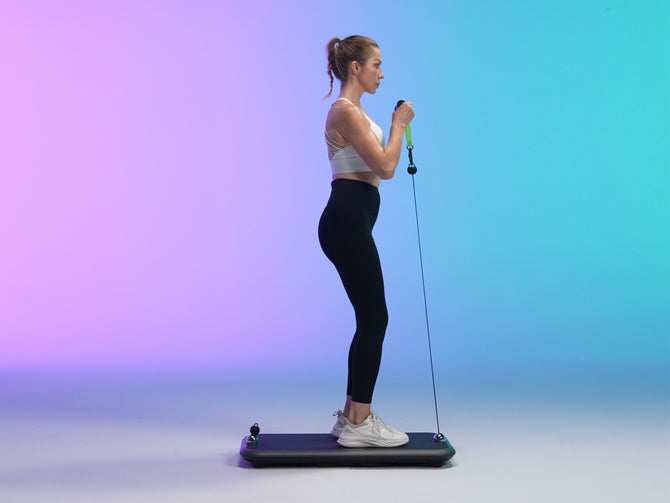
To better understand muscle activation and recruitment during strength training, we conducted a surface electromyography (sEMG) comparative study between the OMNI X1 and traditional strength equipment under identical conditions.
Using professional sEMG equipment, the same participant performed a series of common strength-training movements on both systems. The goal was not simply to determine which machine produced higher numbers, but to evaluate how effectively each movement activated its intended muscle groups.
The results reveal an important insight:
Effective training isn't just about moving resistance—it's about ensuring the right muscles are doing the work.
Bench Press — Greater Chest Dominance on OMNI X1

One of the most common frustrations in chest training is feeling the shoulders and arms fatigue before the chest itself.
In our bench press comparison, both systems produced strong activation patterns.
However, OMNI X1 showed higher pectoralis major activation while reducing triceps involvement, suggesting a more chest-focused stimulus.

| Muscle Group | OMNI X1 (%MVC) |
Traditional (%MVC) |
| Pectoralis Major | 34.8 | 31.4 |
| Triceps | 5.7 | 11.3 |
For users whose goal is maximizing chest engagement, this pattern may help direct more of the training stimulus toward the intended target muscle.
Squat: Higher Lower-Body Load in Traditional Equipment

The squat is one of the most demanding compound movements in strength training, requiring coordinated involvement from the legs, glutes, core, and spinal stabilizers.
In this comparison, traditional equipment produced higher activation in both the quadriceps and erector spinae muscles, reflecting stronger overall lower-body recruitment.

| Muscle Group | OMNI X1 (%MVC) |
Traditional Device (%MVC) |
| Rectus femoris | 30.2 | 34.2 |
| Erector spinae | 20.2 | 30.6 |
Interestingly, OMNI X1 generated noticeably lower erector spinae activation. For some users—particularly beginners—this may help reduce excessive reliance on the lower back while learning proper squat mechanics.
The results suggest that traditional equipment maintains an advantage in total-body loading during squats, while OMNI X1 offers a movement pattern that may be easier to control.
Rope Pushdown — Familiar Movement, Comparable Results

The rope pushdown is one of the most recognizable arm exercises in any gym. Its purpose is straightforward: keep the upper arm stable and allow the triceps to perform the majority of the work.
In testing, average triceps activation was nearly identical between the two systems.

| Metric | OMNI X1 (%MVC) |
Traditional (%MVC) |
| Average Triceps Activation | 22.2 | 22 |
| Mid-Range Peak Activation | 67.6 | 53.7 |
While overall activation remained similar, OMNI X1 produced a higher peak during the most mechanically demanding portion of the movement.
For users, this means familiar training patterns can be maintained while still delivering strong muscular stimulus during key phases of the exercise.
Biceps Curl — Closely Matching Traditional Resistance Training

The biceps curl is a fundamental isolation movement with a highly standardized motion pattern. Because of its simplicity, it serves as a strong indicator of baseline resistance feel and mechanical consistency.
In this comparison, both systems produced nearly identical activation levels.

| Muscle Group | OMNI X1 (%MVC) |
Traditional (%MVC) |
| Biceps Brachii | 37.3 | 39 |
The small difference suggests that OMNI X1 is capable of delivering a resistance experience that closely resembles traditional strength equipment during basic arm training, supporting familiar execution patterns without requiring adaptation in technique.
High Pulldown — The Strongest Result for OMNI X1

Among all exercises tested, the high pulldown produced the most notable advantage for OMNI X1.
Many people struggle to properly engage their back muscles during pulling exercises. The movement gets completed, but much of the workload shifts to the arms.
In this test, OMNI X1 demonstrated higher activation across all major back-related muscle groups.

| Muscle Group | OMNI X1 (%MVC) |
Traditional (%MVC) |
| Latissimus Dorsi | 37.2 | 33.3 |
| Posterior Deltoid | 28.6 | 19.8 |
| Middle Trapezius | 21.3 | 17.3 |
| Biceps Brachii | 16.8 | 12.2 |
These results indicate stronger overall recruitment of the muscles responsible for pulling and scapular control.
Because the primary goal of a lat pulldown is effective back training—not simply moving the handle downward—this finding is particularly meaningful.
For users seeking clearer back engagement, OMNI X1 showed the strongest performance advantage of the entire study.
Cable Crunch — Stronger Abdominal Recruitment

Abdominal training often presents a unique challenge: many people complete the movement without effectively engaging the abdominal muscles themselves.
Neck tension, hip flexor dominance, and compensatory movement patterns are all common.
In the cable crunch comparison, OMNI X1 generated both higher average activation and higher peak activation of the rectus abdominis.

| Metric | OMNI X1 (%MVC) |
Traditional (%MVC) |
| Average Rectus Abdominis Activation | 13.8 | 8.3 |
| Peak Activation | 33.3 | 19.8 |
The data suggest that OMNI X1 more effectively concentrated the training stimulus on the abdominal muscles while producing a stronger peak contraction.
For home users, this may translate into more productive core training without simply increasing repetition count.
Kneeling Row — Traditional Equipment Shows Broader Recruitment

Rowing movements require coordinated activation of the lats, upper back, and rear deltoids. Rather than a single muscle dominating the movement, effective execution depends on balanced recruitment across the posterior chain.
In this comparison, both systems produced meaningful back activation, but with different distribution patterns.

| Muscle Group | OMNI X1 (%MVC) |
Traditional (%MVC) |
| Lat Activation (Avg) | 53.5 | 56.4 |
| Posterior Deltoid | 39.4 | 50.7 |
| Middle Trapezius | 15.2 | 22.6 |
| Lat Peak Activation | 97.8 | 90.2 |
Traditional equipment produced a higher average activation across most back muscles, indicating a more comprehensive recruitment pattern throughout the movement.
However, OMNI X1 achieved a higher peak activation of the latissimus dorsi, demonstrating its ability to generate strong targeted stimulation at key moments during the exercise.
Hip Bridge — Traditional Equipment Maintains an Advantage

The glute bridge appears simple, but it is highly sensitive to body positioning, support structure, and force direction.
When these factors are not optimized, the lower back can become more involved than intended.
In this comparison, traditional equipment showed slightly higher glute activation and substantially lower erector spinae involvement.

| Muscle Group | OMNI X1 (%MVC) |
Traditional (%MVC) |
| Gluteus Maximus | 29 | 31.1 |
| Erector Spinae | 29.8 | 19.4 |
These findings suggest that dedicated lower-body setups tend to better constrain movement pathways, which can reduce compensatory involvement and improve isolation consistency.
Rather than indicating a performance gap, this highlights an area where structural optimization can further refine movement specificity in home-based configurations.
What the Results Tell Us
Across the exercises tested, several clear patterns emerged.
OMNI X1 demonstrated particularly strong performance in movements where target-muscle engagement is often difficult to achieve, including the lat pulldown, cable crunch, and bench press.
In arm isolation exercises such as triceps pushdowns and biceps curls, activation levels closely matched traditional equipment, suggesting a familiar and effective resistance experience.
Meanwhile, traditional equipment continued to show advantages in certain compound movements, particularly where broad muscle recruitment, stabilization demands, or specialized support structures play a larger role.
This sEMG study is not intended to declare a “winner.”
It demonstrates a more fundamental principle:
Effective training is not about completing movement—it is about ensuring the correct muscles are truly engaged.
And ultimately, that's what matters most:
Not just moving resistance.
But moving it with purpose.

The Purpose of Digital Strength

Testing Disclaimer
-
This study was conducted using professional surface electromyography equipment in a standard gym environment. The subject was a recreationally trained individual with consistent training habits. Results may vary depending on individual biomechanics, execution, and environmental conditions.
-
All movements were performed by the same subject in controlled environments. OMNI X1 was tested in standard mode without exercise-specific tuning.
-
This report is for informational and performance reference purposes only and does not constitute medical, clinical, or certified performance validation.


